
- Content
Summer gives children a unique space for development. During the warm season, learning can move beyond the table, notebooks, and the usual “scheduled lessons.” That is why many parents notice that on vacation, a child learns just as much—and sometimes even more—than in a traditional format. It simply happens differently: through play, movement, observation, and genuine interest in the world around them.
When a child counts seashells on the beach, compares leaves in the park, invents stories about forest creatures, or looks for words starting with a certain letter during a walk, they are not just playing. They are developing thinking, speech, attention, memory, and the ability to recognize connections. That is why summer development can be natural, light, and at the same time truly effective.
Why Summer Is Ideal for Learning Through Life
In summer, children move more, see more, and encounter real-life situations where knowledge becomes meaningful. Math is no longer just numbers in a row, and language is no longer an exercise from a textbook. Everything becomes practical: to count, compare, name, describe, invent, and discover.
That is why parents should not worry that a child will “forget everything” over the summer without daily assignments. What matters more is giving them the opportunity to see learning in everyday things. When there is interest, new information is absorbed more easily and retained longer.
To make summer support development, it is helpful to:
- ask simple questions during walks
- involve the child in small observations and counting
- talk about what they see around them
- avoid rushing to give ready-made answers
In such moments, the child does not feel like they are being taught. For them, it is a game, a conversation, and a small discovery—while for parents, it is a natural way to support development without pressure.
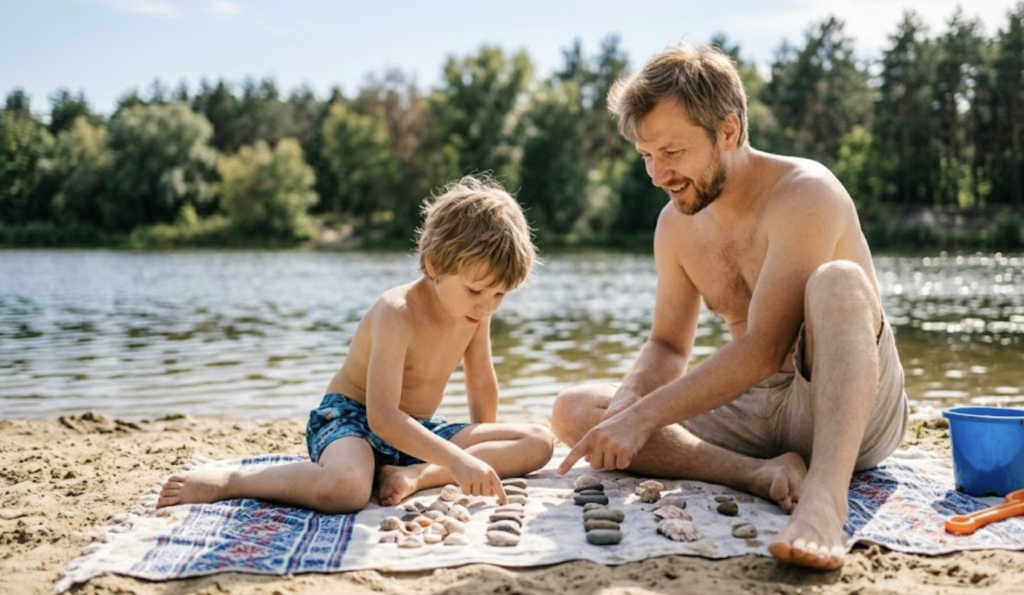
Math on the Beach
A beach or shoreline is a perfect place for simple summer math. Children can count shells, stones, waves, steps to the water, or footprints in the sand. They can compare what is more or less, heavier or lighter, longer or shorter, rounder or smoother. For a child, it feels like a fun game, while at the same time training logic and attention.
Simple ideas that work well:
- collect 5 shells and add 2 more
- arrange stones from smallest to largest
- count how many steps it takes to reach the water
- find objects of the same shape
These actions help children better understand numbers, quantity, sequences, and basic mathematical relationships—all without the feeling of a lesson.
Counting and Comparing
At the beach, children naturally learn to compare objects. Which shell is bigger, how many stones are needed to make ten, what is more—smooth or rough items. Through such simple activities, a sense of quantity and attention to detail develops.
Language in the Forest
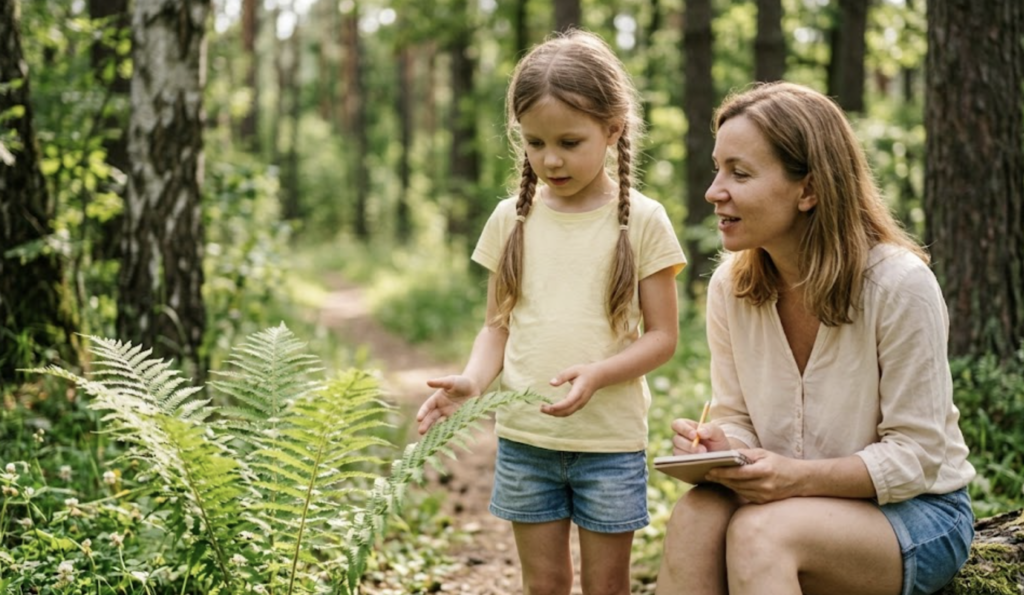
A forest, park, or any green area is ideal for language development. Here, a child sees many new things—and therefore has something to talk about. You can describe trees, leaves, smells, and sounds, look for words starting with a certain letter, choose adjectives, or invent short stories about birds, insects, or forest creatures.
These walks are especially helpful for children who find it difficult to sit still for long. In motion, it is often easier for them to think, speak, and remember. Language develops when a child not only repeats words but uses them in a real context.
During a walk, you can:
- ask the child to describe what they see in three words
- find objects that start with a specific sound
- invent a short story about a tree or a path
- play “who can name more words” on a chosen topic
These games enrich vocabulary and help children express their thoughts more freely.
Observation and Words
Language development is closely connected with observation. The more a child notices, the more they want to name what they see. That is why a walk in the forest can become a perfect opportunity to develop speech naturally, without any pressure.
How to Make Summer Development Natural
The most important thing is not to turn every walk into a lesson. If an adult tries too hard to make everything “educational,” the child quickly loses interest. It is better to keep a sense of ease, playfulness, and joy in shared time. A few well-placed questions, one small task, or a short game along the way is enough.
Summer development works best when it is woven into everyday life. On the beach—counting, in the forest—talking, in the yard—comparing, during a walk—observing. These simple moments create real learning that does not exhaust but inspires.
Summer gives parents a wonderful opportunity to show their child that development does not exist only in books and notebooks. It is all around—in shells, waves, leaves, shadows, stones, words, and conversations. And when adults notice these opportunities, an ordinary day turns into a small adventure where a child grows easily, naturally, and with curiosity about the world.
Ideas for children’s summer development through play, walks, and observation in different environments.